News & Posts
Effect of global change drivers on carbon fluxes and resilience of European forests
Cite research as:
Gharun, A., Angove, C., Migliavacca, M., Zhou, Y., Buckeridge, K., Branquinho, C., Collalti, A., Nybakken, L., Zhiyanski, M., Sarginci, M., Koc, I., Donmez, A. H., López-Ballesteros, A., Godbold, D., Machacova, K., Guidi, C., Koren, G., Ostonen, I., Sell, M., Pers-Kamczyc, E., Kamczyc, J., Aslan, T., Preece, C., Prikaziuk, E., Özkan, U., Vitali, V., Havrdová, A., Grünzweig, J. M., Tomelleri, E., Ullah, S., Stoeva, L., Nestola, E., Vanguelova, E., Guerrieri, R. (2026). Perspectives: Effect of global change drivers on carbon fluxes and resilience of European forests. Forest Ecology and Management, 616, 123844. https://doi.org/10.1016/j.foreco.2026.123844
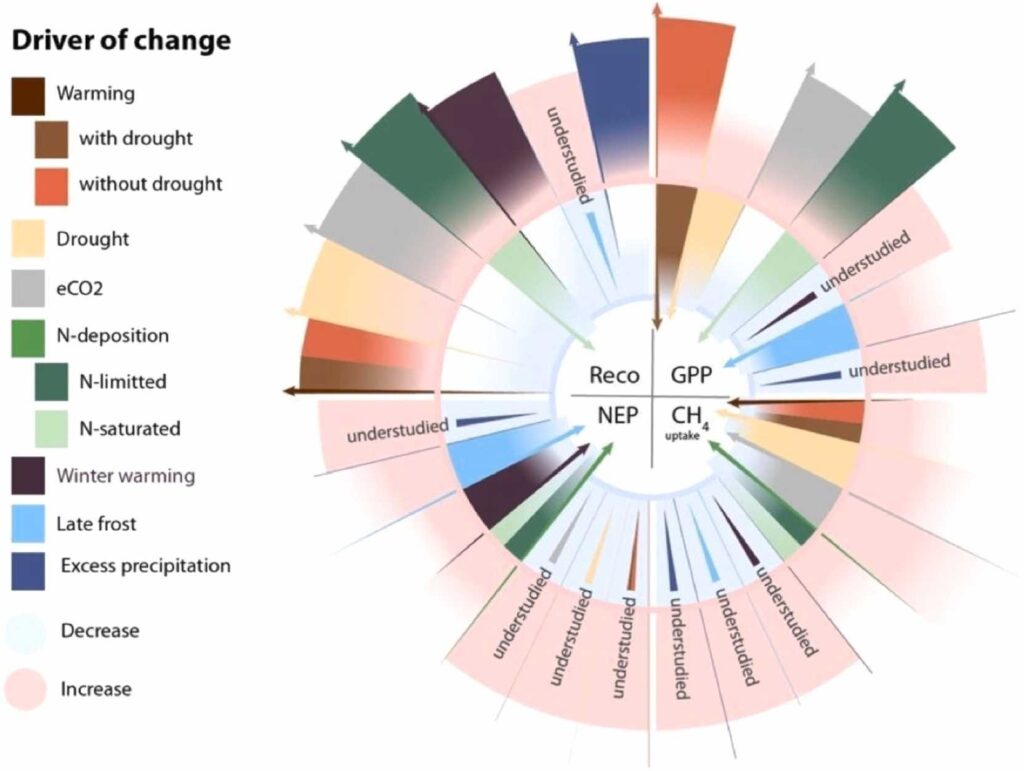
Excited to share our new review paper on “Effect of global change drivers on carbon fluxes and resilience of European forests”, co-authored by our team member Alena Havrdová. In this paper we synthesise current knowledge on how global change drivers (e.g., elevated CO2, drought, heatwave, nitrogen deposition, and understudied extremes) affect forest carbon fluxes (CO2 and CH4) and resilience. We identify key knowledge gaps and discuss priorities for future research and monitoring.
Key messages from the paper:
🌍 Forest responses to climate extremes are becoming more complex and less predictable
📉 Forest dynamics are shaped by interacting global change drivers, making single-driver assessments insufficient for predicting ecosystem responses
🔎 Understanding forest resilience requires long-term observations that capture the dynamic feedbacks among ecophysiological processes, soil biogeochemistry, and disturbance regimes.
Read the full paper developed as part of CLEANFOREST COST Action, here:
https://www.sciencedirect.com/science/article/pii/S0378112726003427
Abstract: European forests play a central role for meeting the EU’s climate targets, but the declining carbon sink has left them trailing behind climate goals. Reversing this trend requires a systematic understanding of forest responses to shifting global change drivers, explicitly integrating aboveground and belowground processes. Here, we provide our perspective on the effects of multiple global change drivers on ecosystem-scale carbon fluxes (including both carbon dioxide (CO2) and methane (CH4)) and the resilience of these fluxes, based on direct flux observations (e.g., from eddy covariance towers). First, we present changes in several key drivers (warming, drought, atmospheric CO2, nitrogen deposition, winter warming, excess precipitation, late frost), over recent decades, some of which (winter warming, windthrow, excess precipitation, late frost) have received limited attention in forest carbon assessments. Some of these—such as winter warming—are expected to become increasingly frequent in the future. We then explicitly summarize how the four (more-frequently studied) key drivers affect carbon fluxes (i.e., CO2 and CH4 fluxes). The response of the net CO2 sink (i.e., net ecosystem productivity) is presented through its two component processes: gross primary productivity (GPP) and ecosystem respiration (Reco). When considered individually, global change drivers often produce relatively predictable responses in forest carbon fluxes: warming tends to enhance both GPP and Reco, elevated atmospheric CO₂ generally stimulates photosynthesis, and moderate nitrogen (N) inputs can enhance productivity in N-limited systems. However, when drivers interact, ecosystem responses frequently become non-linear, amplified, or even reversed relative to single-driver expectations. For example, warming alone may extend the growing season and increase GPP, but in combination with drought, elevated vapor pressure deficit suppresses stomatal conductance, reduces GPP, and can increase respiration losses during rewetting events. Similarly, the positive effect of rising CO₂ on productivity may be constrained by nutrient limitation or drought stress, while historical N deposition can temporarily sustain CO₂ fertilization effects but also increase vulnerability to climatic stressors. Under compound disturbances—such as drought followed by extreme precipitation or winter warming—ecosystem respiration pulses and structural damage can further reduce net ecosystem productivity (NEP). Collectively, these findings indicate that forest carbon dynamics cannot be reliably inferred from single-driver responses alone; instead, interacting drivers shape ecosystem resilience through feedbacks among physiological processes, soil biogeochemistry, and disturbance regimes, often leading to thresholds or tipping points in carbon sink strength.
Keywords: Gross primary productivity; Respiration; Ecosystem; Climate extremes; Air pollution; Nitrogen deposition; Drought; Heatwave
- May 28, 2026
- Research